
+1000 solutions listed
40+ regulations & frameworks


58% of organizations use 25+ cybersecurity tools and 28% manage over 50.
Analysts spend more time maintaining tools than defending the organization.
No integration between tools means no consolidated compliance view.
Breaches and ransomware at record levels with no sign of slowing.
62% of system intrusion incidents are caused by vendors and supply chains.
Third-party risk is the top security priority but teams can't keep up.
Verifying one vendor takes 3 to 12 weeks of questionnaires.
Vulnerabilities are weaponized faster than teams can patch.

49% of security teams cite lack of skills as their greatest challenge.
Compliance management is the most critical skill gap across security teams.
Compliance is increasingly complex to manage across multiple frameworks.
SIG questionnaires reach 1,936 questions.

62% of system intrusion incidents are caused by vendors and supply chains.
Organizations rank third-party risk as their top priority but can't assess it.
Most OT organizations faced at least one intrusion in the past 12 months.
18 minutes average breakout time from initial compromise to lateral movement.

68% of industrial companies are unfamiliar with their OT regulatory obligations.
Regulations overlap but evidence requirements don't.
NIS2 requires 24-hour incident notification and 72-hour reporting.
NERC CIP, NCA OTCC, IEC 62443 each define OT controls differently.

60% of organizations cite lack of internal resources as their main OT security barrier.
ICS/OT security budgets rarely fall under the CISO.
IT and OT teams operate in silos with conflicting priorities.
OT compliance frameworks are growing more complex to manage.
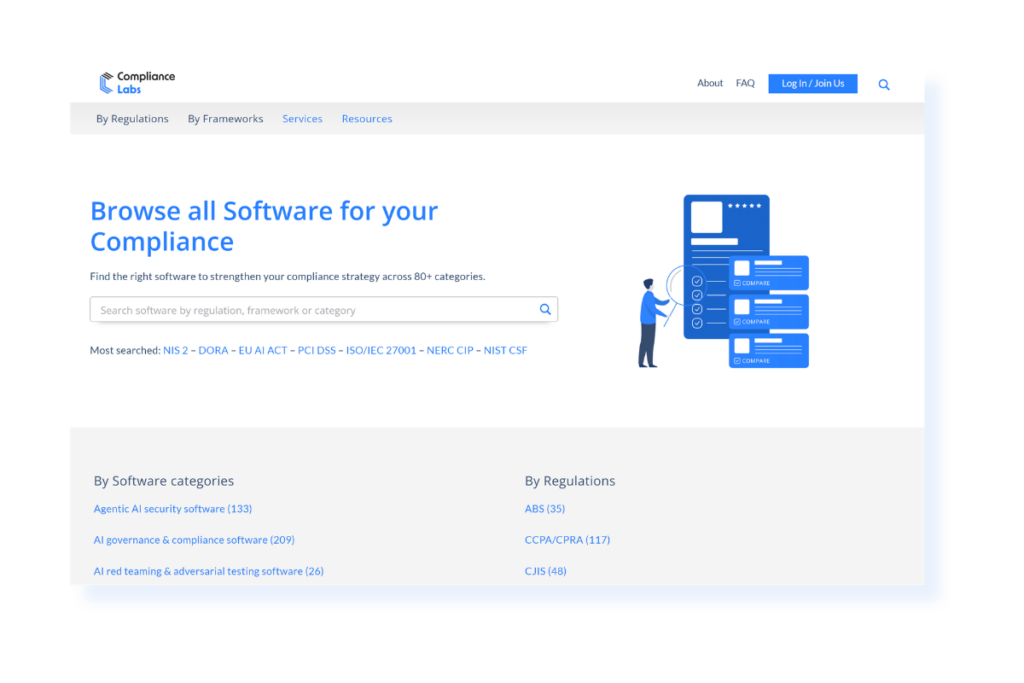
Your compliance obligations depend on your sector, geography, and the data you process. Compliance Labs lets you search cybersecurity software by the regulation that applies to you, across 40+ regulations and frameworks. OT environments get dedicated coverage with NERC CIP, NIS2, NIST SP 800-82, and ICS protocol filters built into the search.
Find the right software by filtering across regulation, framework, sector or capability, so you reach what matters fast.
Place the software you already use side by side to see how each covers the regulations and frameworks evaluated, and where gaps remain.
Compare competing software side by side on regulatory coverage, capabilities and threat results to choose the strongest fit.
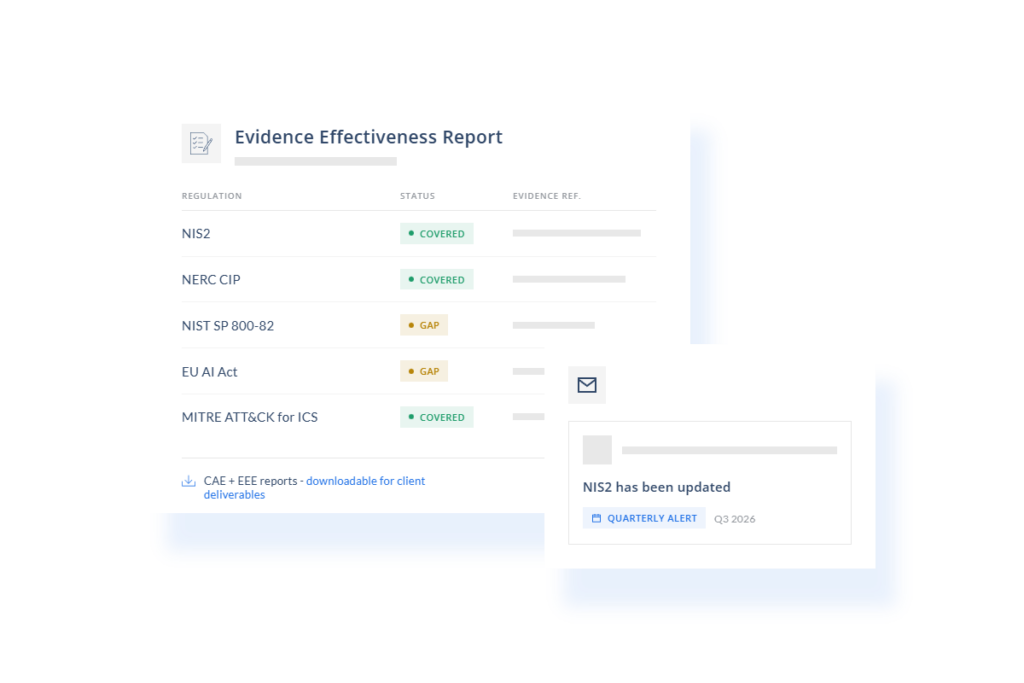
Access ready-to-use tools, guides, templates and policies that accelerate your compliance work across every client engagement.
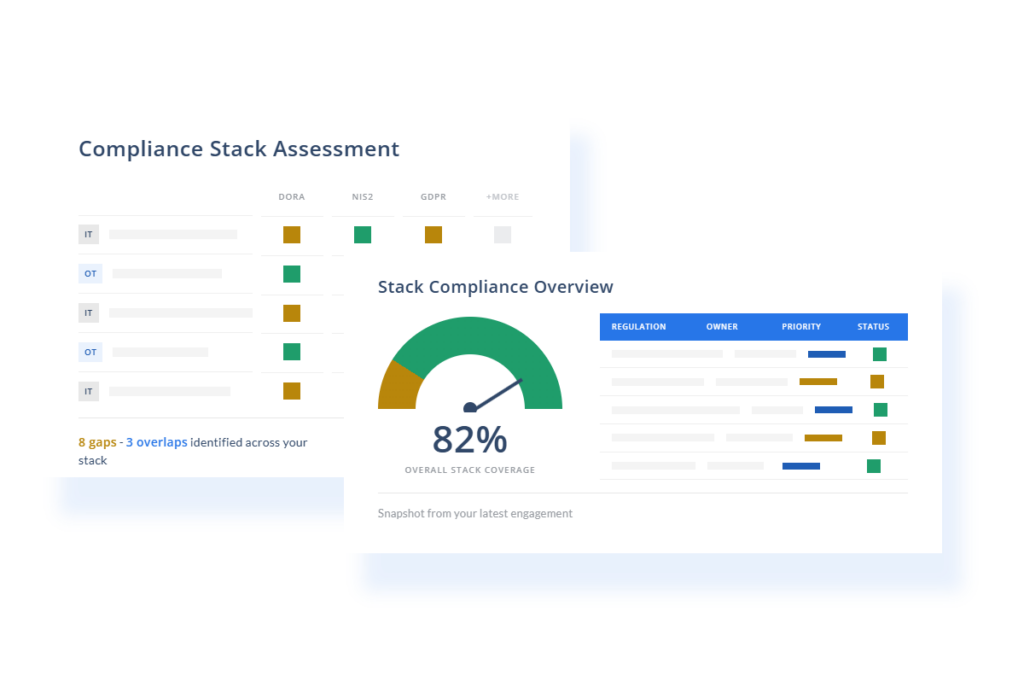
From procurement decision to operational compliance, Compliance Labs provides expert support and structured data for your teams across cloud, SaaS, ICS, and SCADA environments. For OT operators preparing for NIS2, gap analysis aligns to essential and important entity requirements with a clear remediation path tailored to your infrastructure.

Financial entities must address ICT risk, third-party oversight and resilience testing.

Hospitals and healthtech companies must protect patient health data across complex vendor ecosystems.

Defense contractors and Agencies must demonstrate compliance with federal security requirements.
Tech companies selling to regulated buyers must address multiple regulations and frameworks.

Operators of critical infrastructure must address operational technology and grid security.
25+ years of compliance practice across IT and OT environments.
Sector: Major European telecom operator managing mobile, fixed-line and enterprise services infrastructure.
Context: The operator faced simultaneous obligations across NIS2 (essential entity), GDPR (subscriber data), ISO 27001 (enterprise security) and RGS (government services).
Challenge: No unified compliance view existed across frameworks. Security audits against ISO 27001 covered one perimeter, GDPR assessments covered another, and NIS2 readiness was handled separately. The same software stack was assessed three times against three different sets of requirements with no cross-mapping.
Consequence: Redundant audit efforts. Remediation plans conflicted. The compliance team could not answer a simple question: does this software address all our regulatory requirements?
Compliance takeaway: Multi-framework compliance requires cross-mapping, not parallel assessments. Unified compliance maps per software covering regulations (NIS2, GDPR) and frameworks (ISO 27001, NIST CSF) eliminate redundant work and give the compliance team one answer per product.
Sector: European reinsurance company operating across multiple jurisdictions with complex regulatory exposure.
Context: We conducted executive-level risk profiling through interviews with CEO, CFO, CIO and CISO to identify sensitive business assets, associated risks and organizational maturity across all business lines.
Challenge: The reinsurer had multiple compliance programs running in parallel, including Solvency II, GDPR and ISO 27001, each handled by a different team with a different methodology. The IT software stack had never been evaluated against regulatory requirements in a structured way. No shared compliance reference existed across teams. The objective was to define a common security policy framework applicable to all entities, but without knowing how the software addressed each regulation, the framework remained theoretical.
Consequence: Three compliance programs, no shared data. The board received fragmented reporting. Procurement decisions were made without knowing whether new tools addressed existing regulatory gaps or created new ones.
Compliance takeaway: Enterprise risk management requires compliance visibility at the software level. Structured compliance maps per product across regulations (GDPR, DORA) and frameworks (ISO 27001, NIST CSF) give the board a unified view and turn a theoretical policy framework into an actionable compliance baseline.
Sector: Banks and payment application vendors requiring security validation before production deployment.
Context: Banking applications processing card data and sensitive financial transactions required security validation against PCI DSS and internal security standards before deployment or certification.
Challenge: Each application audit required evaluating the security management system, logical and physical infrastructure, sector-specific risks, contractual requirements and human resource controls. Penetration testing covered application-level vulnerabilities, authentication weaknesses and data exposure risks. Vendor applications were assessed against both regulatory requirements and internal security policies, but no structured reference existed to compare how different vendors addressed the same controls.
Consequence: Every application audit was a standalone engagement. Findings from one vendor could not be compared to another. Procurement teams had no way to evaluate competing solutions against the same compliance criteria before selecting a vendor.
Compliance takeaway: Application security validation needs a comparable reference. When procurement evaluates competing payment solutions, structured compliance maps per software against PCI DSS and PA-DSS give teams objective, side-by-side comparison instead of vendor-specific audit reports that cannot be compared.
Sector: Major European gas transmission operator, 50+ industrial sites across multiple countries, classified as critical national infrastructure.
Context: The operator’s OT environment relied on equipment from over a dozen major industrial vendors including ABB, Schneider, Siemens, Baker Hughes, GE, Solar, Thermodyn and Clemessy.
Challenge: Over 100 cybersecurity acceptance tests (FAT/SAT) were required across European sites for PLCs, safety systems (APS), compression packages, RTUs and programming consoles. No vendor provided structured compliance evidence. Every test plan had to be built from scratch for every vendor on every project.
Consequence: The security team became the bottleneck for industrial project delivery. Months of preparation per project, no reusability between vendors, no scalability.
Compliance takeaway: When no vendor provides regulatory evidence, the burden falls entirely on the operator. Pre-evaluated vendor compliance maps against regulations (NCA OTCC, NIS2) and frameworks (NIST SP 800-82) replace months of manual FAT/SAT preparation. One evaluation per vendor, reusable across every project and every site.
Sector: European motorway concession operators managing thousands of kilometers including tunnels, toll systems, traffic management and emergency infrastructure.
Context: Motorway operators depend on SCADA systems for tunnel ventilation, fire detection, traffic flow control, toll collection and emergency communications. These systems were designed for safety and availability, not cybersecurity.
Challenge: Each concession operated independently with different equipment vendors, different architectures and different levels of OT maturity. No structured assessment existed to evaluate whether deployed OT software addressed regulatory requirements. Risk assessments had to cover both physical safety and cybersecurity. Transactional payment systems added PCI DSS requirements on top of OT obligations.
Consequence: No way to compare compliance posture across concessions. Every assessment was a bespoke engagement. Regulatory pressure mounting with NIS2 classifying transport as essential entities.
Compliance takeaway: Operators with hundreds of distributed SCADA systems cannot assess each vendor individually. Compliance maps per OT software and one search by regulation show which solutions address transport-specific requirements across both safety and cybersecurity domains.
Sector: Major European energy utilities operating power generation, transmission and distribution infrastructure, classified as operators of vital importance.
Context: The utilities operated under dual compliance pressure: enterprise IT policies governed by ISO 27001 and national regulations, and OT-specific requirements driven by defense regulations (LPM) and industrial standards.
Challenge: IT security teams managed enterprise controls but had no visibility on OT-specific risks such as safety system isolation, industrial protocol security and obsolescence in air-gapped environments.
Consequence: Two parallel audit trails with no shared reference. Findings fragmented, remediation plans contradicted each other, and the board received two different versions of the compliance posture.
Compliance takeaway: IT/OT governance harmonization fails without a shared compliance reference. Unified compliance maps covering IT regulations (NIS2) and OT frameworks (NIST SP 800-82, MITRE ATT&CK ICS) provide one source of truth instead of two separate audit trails.
The expertise behind every compliance map, evaluation and report.
Vendor-neutral assessments designed for security, risk teams and audit-ready documentation.

Supporting organizations across IT, OT and AI compliance programs since 2000.

Designed by former compliance officers who understand regulatory pressure across industries.